
Only about 4% of babies arrive on their actual due date. Four percent. That means 96 out of every 100 pregnancies end on a day that wasn't circled on the calendar. Yet that single date becomes the organizing principle for nine months of planning, appointments, and anticipation. Understanding how due dates work — and how much flexibility they actually carry — can save you a lot of unnecessary stress.
How Due Dates Are Calculated
A pregnancy due date is an estimate of when your baby will reach full term, defined as 40 weeks of gestational age. The most common calculation method starts from the first day of your last menstrual period (LMP), not from the date of conception. This distinction matters because most people know when their period started but don't know the exact day fertilization occurred.
The standard formula adds 280 days (40 weeks) to the first day of your LMP. If your last period started on January 1, your estimated due date would be October 8. That's approximately nine calendar months and one week forward.
Healthcare providers typically confirm or adjust this estimate with an ultrasound during the first trimester. According to the American College of Obstetricians and Gynecologists (ACOG), first-trimester ultrasound is the most accurate method for establishing gestational age, with a margin of error of about 5 to 7 days.
You can calculate your own estimated due date instantly using our Pregnancy Due Date Calculator, which applies this standard medical formula automatically.
Understanding Naegele's Rule
The formula most doctors use has a name: Naegele's Rule, developed by German obstetrician Franz Naegele in the early 1800s. The rule is straightforward:
Due Date = LMP + 1 year - 3 months + 7 days
Here's how it works step by step with a concrete example:
- Start with LMP: March 15, 2026
- Add one year: March 15, 2027
- Subtract three months: December 15, 2026
- Add seven days: December 22, 2026
This gives you the same result as counting 280 days forward, but it's easier to do in your head.
Naegele's Rule carries an important assumption: it presumes a 28-day menstrual cycle with ovulation occurring on day 14. If your cycle is consistently longer or shorter than 28 days, the estimate shifts. A 35-day cycle, for example, means you likely ovulated around day 21 instead of day 14 — pushing your actual due date about a week later than what Naegele's Rule predicts.
Some providers use a modified version of the rule that accounts for cycle length variation. The Mittendorf-Williams Rule, developed from a 1990 study, found that first-time mothers carried an average of 288 days from LMP (eight days longer than the standard estimate), while subsequent pregnancies averaged 283 days.
The takeaway: Naegele's Rule is a starting point, not a precise prediction. Your provider will refine it with additional data as your pregnancy progresses.
Week-by-Week Pregnancy Milestones (Summary Table)
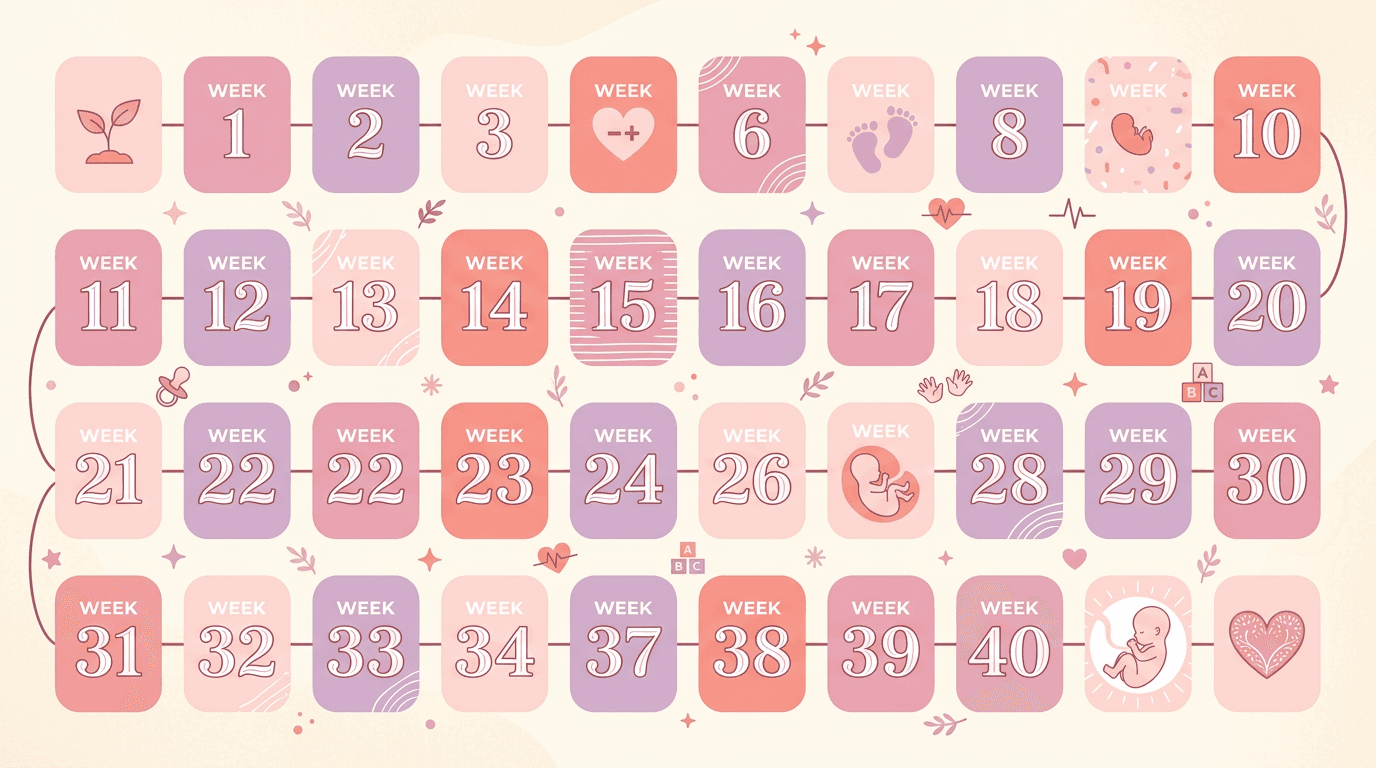
Pregnancy is divided into three trimesters, and each week brings measurable changes. The table below summarizes key developmental milestones and approximate fetal size at various points. These are averages — individual variation is completely normal.
| Week | Trimester | Fetal Size (approx.) | Key Milestone |
|---|---|---|---|
| 4 | 1st | Poppy seed (~2 mm) | Implantation complete; pregnancy hormone (hCG) detectable |
| 6 | 1st | Sweet pea (~6 mm) | Heart begins beating; neural tube forming |
| 8 | 1st | Raspberry (~16 mm) | All major organs have begun to form; fingers developing |
| 10 | 1st | Strawberry (~3 cm) | Officially called a "fetus"; vital organs functioning |
| 12 | 1st | Lime (~5.5 cm) | Reflexes developing; first trimester screening window |
| 16 | 2nd | Avocado (~12 cm) | Gender may be visible on ultrasound; bones hardening |
| 20 | 2nd | Banana (~25 cm) | Anatomy scan (mid-pregnancy ultrasound); movement felt |
| 24 | 2nd | Ear of corn (~30 cm) | Viability milestone; lungs developing surfactant |
| 28 | 3rd | Eggplant (~37 cm) | Eyes can open and close; sleep cycles begin |
| 32 | 3rd | Jicama (~42 cm) | Rapid brain development; practice breathing |
| 36 | 3rd | Honeydew melon (~47 cm) | Head may engage in pelvis; considered "early term" at 37 weeks |
| 40 | 3rd | Watermelon (~50 cm) | Full term; average birth weight 3.0-3.6 kg (6.6-8.0 lbs) |
Tracking where you are in this timeline helps you prepare for upcoming appointments, tests, and decisions. A good Pregnancy Due Date Calculator will tell you your current week and trimester alongside your estimated delivery date.
Ultrasound vs. Last Menstrual Period — Which Is More Accurate?
Both methods are used in clinical practice, but they measure different things and have different accuracy windows.
LMP-based dating relies on your memory of when your last period started and assumes a textbook 28-day cycle. It's simple and requires no equipment, which is why it remains the default starting point. However, irregular cycles, spotting mistaken for a period, or uncertain dates can throw the estimate off by two weeks or more.
Ultrasound dating measures the fetus directly. In the first trimester (before 14 weeks), crown-rump length (CRL) measurements are highly consistent across pregnancies. A first-trimester ultrasound can estimate gestational age within plus or minus 5 to 7 days. By the second trimester, accuracy drops to plus or minus 10 to 14 days. By the third trimester, the margin widens to plus or minus 21 days, because babies grow at increasingly individual rates.
ACOG guidelines (Practice Bulletin No. 700, reaffirmed 2023) recommend the following hierarchy:
- Before 9 weeks: Ultrasound is accurate within 5 days. If it disagrees with LMP by more than 5 days, use the ultrasound date.
- 9 to 13+6 weeks: Accurate within 7 days. Ultrasound takes priority if discrepancy exceeds 7 days.
- 14 to 15+6 weeks: Accurate within 10 days.
- 16 to 21+6 weeks: Accurate within 14 days.
- 22 weeks and beyond: Accurate within 21 days.
In practice, your provider will compare the LMP-based estimate with the first ultrasound measurement. If they agree within the accuracy window for the gestational age at the time of the scan, most providers will keep the LMP-based date. If there's a significant discrepancy, the ultrasound date replaces it.
For example, if your LMP suggests you're 8 weeks pregnant but the ultrasound measures a CRL consistent with 9 weeks and 3 days — a difference of more than 7 days — your provider will likely adjust your due date to match the ultrasound.
When and Why Your Due Date Might Change
Having your due date moved can be unsettling. You've already told family, maybe planned maternity leave around a specific week, and suddenly the timeline shifts. Here are the most common reasons it happens.
First-trimester ultrasound discrepancy. As described above, if the first ultrasound disagrees with LMP-based dating by more than the expected margin of error, the due date gets revised. This is the most common and most reliable reason for a change.
Irregular menstrual cycles. If your cycles run 35 to 45 days, or if you have conditions like polycystic ovary syndrome (PCOS) that affect ovulation timing, the LMP date may have been inaccurate from the start. The ultrasound provides a correction.
Conception via assisted reproduction. For pregnancies conceived through IVF or IUI, the date of embryo transfer or insemination is known precisely. These pregnancies use a calculation based on the known conception date rather than LMP, and the due date is typically very accurate from the beginning.
Late entry to prenatal care. If your first ultrasound doesn't happen until the second or third trimester, the accuracy is lower and the due date assignment carries more uncertainty. Your provider may give a wider estimated delivery window rather than a single date.
Growth patterns on follow-up scans. Later ultrasounds sometimes reveal that the baby is measuring significantly larger or smaller than expected. This doesn't usually change the official due date, but it can influence decisions about delivery timing — particularly if there are concerns about intrauterine growth restriction or macrosomia (a larger-than-average baby).
The key point: a changed due date doesn't mean something went wrong. It usually means your provider has better data now than they did at the start.
Trimester-by-Trimester Checklist
Knowing what to expect and when to act makes the journey smoother. The checklist below covers major milestones, medical appointments, and practical tasks organized by trimester.
First Trimester (Weeks 1-13)
| Task | When | Details |
|---|---|---|
| Confirm pregnancy with home test | Weeks 4-5 | Test after a missed period; hCG levels are typically detectable by this point |
| Schedule first prenatal visit | Weeks 6-8 | Includes medical history, blood work, and possibly an early ultrasound |
| Begin prenatal vitamins | Immediately | Folic acid (400-800 mcg daily) is critical for neural tube development |
| First-trimester screening | Weeks 11-13 | Nuchal translucency ultrasound plus blood tests for chromosomal conditions |
| Announce pregnancy (optional) | After week 12 | Miscarriage risk drops significantly after the first trimester |
| Research prenatal care options | Weeks 8-12 | Choose OB-GYN, midwife, or birth center; verify insurance coverage |
| Adjust diet and medications | Immediately | Consult provider about any current medications; avoid alcohol, raw fish, and high-mercury foods |
Second Trimester (Weeks 14-27)
| Task | When | Details |
|---|---|---|
| Anatomy scan (mid-pregnancy ultrasound) | Weeks 18-22 | Detailed scan of baby's organs, limbs, and growth; gender can often be determined |
| Glucose screening test | Weeks 24-28 | Tests for gestational diabetes; one-hour glucose challenge test is standard |
| Tdap vaccination | Weeks 27-36 (ideally) | Protects newborn from whooping cough; recommended by CDC in each pregnancy |
| Start birthing/parenting classes | Weeks 20-24 | Many hospitals and community centers offer multi-week courses |
| Create a baby registry | Weeks 18-24 | Research major purchases (car seat, crib, stroller) before registering |
| Begin nursery preparation | Weeks 20-27 | Paint, assemble furniture, and set up the room while energy levels are higher |
| Review workplace maternity leave | Weeks 16-20 | Understand your employer's policy and any applicable short-term disability benefits |
Third Trimester (Weeks 28-40+)
| Task | When | Details |
|---|---|---|
| Group B strep (GBS) test | Weeks 36-37 | Vaginal/rectal swab; positive results mean IV antibiotics during labor |
| Kick count monitoring | Starting week 28 | Track daily fetal movement; contact provider if pattern changes significantly |
| Pack hospital bag | Weeks 35-36 | Include essentials for you, your partner, and the baby |
| Install car seat | Weeks 35-37 | Many fire stations and hospitals offer free installation checks |
| Pre-register at hospital/birth center | Weeks 32-36 | Saves time on paperwork when labor begins |
| Write a birth plan | Weeks 32-36 | Outline your preferences for labor, pain management, and immediate postpartum |
| Pediatrician selection | Weeks 32-36 | Schedule a "meet and greet" appointment; confirm insurance acceptance |
| Prepare freezer meals | Weeks 34-38 | Stock up on easy-to-reheat meals for the postpartum weeks |
These timelines are guidelines, not rigid deadlines. Every pregnancy is different, and your provider may adjust the schedule based on your individual health needs.
Keeping your overall health in check matters throughout pregnancy. Tools like a BMI Calculator can help you and your provider monitor healthy weight gain ranges as your pregnancy progresses, since recommended weight gain varies by pre-pregnancy BMI category.
FAQ
How accurate is a pregnancy due date calculator?
A due date calculator based on the LMP method is a reliable starting point, typically accurate within one to two weeks for people with regular 28-day cycles. ACOG considers first-trimester ultrasound the gold standard for dating accuracy, with a margin of plus or minus 5 to 7 days. The calculator gives you the same result a healthcare provider would compute using Naegele's Rule — the difference is that a provider may refine the estimate with ultrasound data. If you have irregular cycles, the calculator's output should be treated as a rough estimate until confirmed by a scan.
Can my due date change during pregnancy?
Yes, and it's more common than you might think. The most frequent scenario is an adjustment after the first-trimester ultrasound, when the measured fetal size doesn't match the LMP-based estimate closely enough. ACOG provides specific discrepancy thresholds — for example, more than 5 days before 9 weeks or more than 7 days between 9 and 14 weeks — that trigger a due date revision. Once established by a first-trimester ultrasound, the due date rarely changes again, even if later scans show slightly different growth measurements.
What is the difference between gestational age and fetal age?
Gestational age is counted from the first day of your last menstrual period, which is about two weeks before conception actually occurs. Fetal age (also called embryonic age or conceptional age) counts from the estimated date of fertilization. This means a pregnancy described as "10 weeks gestational age" has a fetus that is approximately 8 weeks old. Medical practice and all standard due date calculations use gestational age. When your provider says you're 12 weeks along, they're using gestational age — the baby has been developing for roughly 10 weeks.
What happens if I go past my due date?
Going past your due date is common, especially for first-time mothers. ACOG defines "early term" as 37 to 38 weeks, "full term" as 39 to 40 weeks, "late term" as 41 weeks, and "post-term" as 42 weeks and beyond. Most providers will begin discussing induction options between 41 and 42 weeks, because the risks of stillbirth and complications increase gradually after 41 weeks. The ARRIVE trial (2018) found that elective induction at 39 weeks for low-risk first-time mothers did not increase cesarean rates and was associated with lower rates of hypertensive disorders. However, the decision to induce is always individual and should involve a thorough conversation with your care team about the benefits and risks for your specific situation.
Pregnancy timelines can feel overwhelming when you're living inside them week by week. A reliable Pregnancy Due Date Calculator gives you a clear starting point — one anchor date around which you can organize appointments, prepare your home, and track your baby's growth. Just remember that your due date is an estimate, not an expiration date. Babies arrive on their own schedule, and the goal of all this tracking is simply to make sure you and your care team are ready whenever that day comes.